
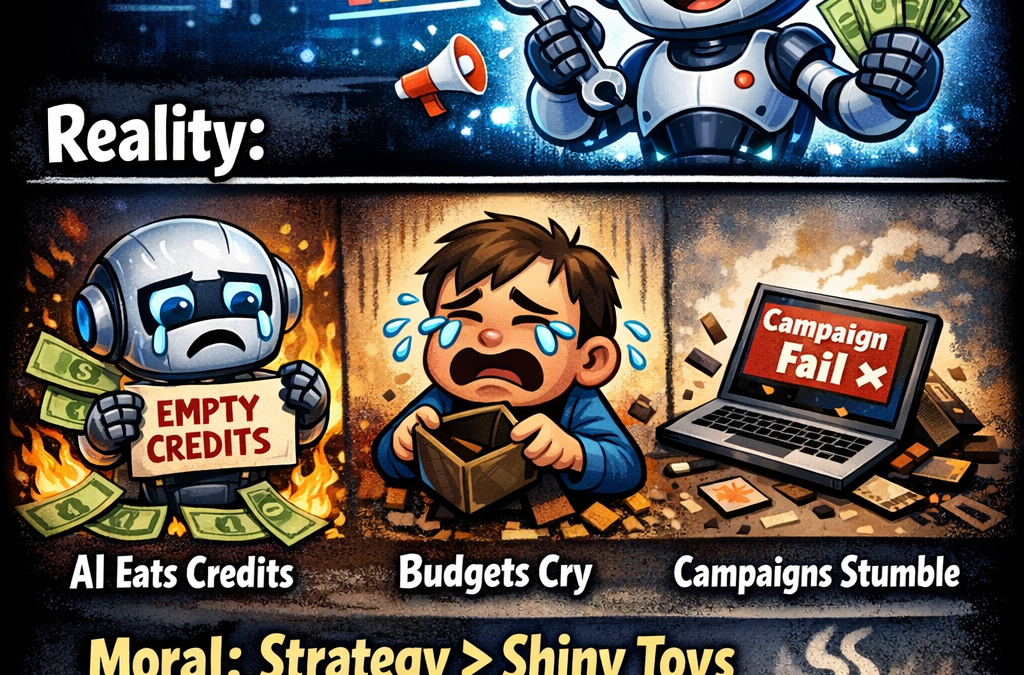
“AI will fix everything.”
It’s the modern business mantra. From startups to enterprise companies, artificial intelligence is being treated like a miracle solution — a shortcut to growth, automation, and instant profitability. Marketing teams believe AI will generate endless leads. Sales teams expect it to close deals automatically. Business owners assume it will reduce costs while multiplying revenue.
But here’s the uncomfortable truth:
AI doesn’t fix broken strategy.
In fact, without a clear plan, AI often makes problems bigger, faster, and more expensive.
Let’s explore why.
The AI Hype Cycle
Artificial intelligence is powerful. Tools can now:
- Generate content in seconds
- Automate ad campaigns
- Analyze massive data sets
- Personalize customer journeys
- Predict buying behavior
The capabilities are impressive — even revolutionary.
But hype creates unrealistic expectations.
Many companies adopt AI tools without defining:
- Their target audience clearly
- Their brand positioning
- Their unique value proposition
- Their measurable goals
- Their customer acquisition strategy
When these fundamentals are unclear, AI simply accelerates confusion.
Imagine pouring high-octane fuel into a car with no steering wheel. It may move fast — but not in the right direction.
AI Eats Budget Without Direction
One of the most common business mistakes is tool obsession.
Companies subscribe to multiple AI platforms:
- AI content generators
- AI ad optimization tools
- AI chatbots
- AI CRM automation systems
- AI analytics dashboards
Monthly subscriptions pile up. Teams experiment randomly. Campaigns launch quickly.
But results?
Often inconsistent.
Why?
Because tools amplify execution — not thinking.
If your marketing message is weak, AI will produce more weak content.
If your targeting is unclear, AI will optimize toward the wrong audience.
If your funnel is broken, AI will send traffic into a leaking system.
The outcome:
- Ad spend increases
- ROI decreases
- Frustration grows
AI didn’t fail. Strategy did.
Campaigns Don’t Fail — Planning Does
A common belief is that “AI ads don’t work.”
In reality, campaigns fail due to:
- Poor offer clarity
- Weak differentiation
- Lack of audience research
- No testing framework
- Unrealistic expectations
AI can optimize bidding and placement, but it cannot:
- Define your brand voice
- Create authentic emotional resonance
- Understand cultural nuance perfectly
- Replace deep customer empathy
Great marketing starts with understanding people — their fears, desires, motivations, and problems.
AI can assist research.
Humans must interpret it.
Without strategic direction, AI-powered campaigns simply scale mediocrity.
Humans Still Drive Vision
The strongest businesses use AI as a multiplier — not a replacement.
Human intelligence provides:
- Creative direction
- Strategic planning
- Ethical judgment
- Brand storytelling
- Long-term vision
AI provides:
- Speed
- Efficiency
- Pattern recognition
- Automation
- Data analysis
When combined properly, the result is powerful.
But remove human strategy, and AI becomes an expensive shortcut.
And shortcuts rarely build sustainable brands.
The Shortcut Mentality Is Dangerous
The attraction to AI often comes from a desire for speed.
“Can we automate growth?”
“Can we reduce staff?”
“Can we generate content without hiring writers?”
“Can AI run ads without a marketing team?”
These questions focus on replacing effort rather than improving effectiveness.
Shortcuts ignore the foundational truth of business:
Growth comes from value.
AI cannot create real value without understanding your market deeply.
It cannot define your mission.
It cannot build trust by itself.
It cannot replace leadership.
What it can do is scale whatever foundation already exists — good or bad.
Strategy First, Technology Second
Before adopting any AI tool, businesses should ask:
- What is our clear objective?
- Who exactly is our ideal customer?
- What problem are we solving?
- What makes us different?
- How do we measure success?
- What is our customer journey?
Only after answering these questions should AI enter the picture.
AI works best when:
- Goals are measurable
- Messaging is clear
- Brand positioning is defined
- Systems are structured
In this environment, AI becomes an accelerator.
Without structure, it becomes chaos.
Why Businesses Panic With AI
Another common pattern:
Companies expect immediate results from AI.
When results don’t appear instantly:
- Budgets increase rapidly
- Campaigns change too quickly
- Strategies shift weekly
- Teams blame tools
This panic destroys consistency.
AI optimization requires:
- Testing
- Data collection
- Iteration
- Patience
Without discipline, companies burn credits chasing quick wins.
Ironically, the solution isn’t more automation.
It’s more clarity.
The Winning Formula
The businesses that truly benefit from AI follow a simple hierarchy:
- Strategy
- Systems
- Skilled People
- Technology
Not the other way around.
They use AI to:
- Enhance research insights
- Improve customer segmentation
- Automate repetitive tasks
- Refine ad targeting
- Increase productivity
But decision-making remains human-led.
They understand that AI is a powerful assistant — not a CEO.
Real Growth Requires Thinking
There is no replacement for:
- Understanding your customer
- Crafting compelling offers
- Building trust
- Delivering consistent value
- Maintaining brand integrity
AI can assist with execution.
It cannot replace thinking.
And thinking is what creates competitive advantage.
Practical Steps to Use AI Wisely
If you want AI to work for your business — not against it — follow these steps:
1. Define Clear KPIs
Know exactly what success looks like before launching any AI-powered campaign.
2. Audit Your Funnel
Ensure your website, landing pages, and conversion systems are optimized.
3. Train Your Team
AI tools are only as effective as the people using them.
4. Start Small
Test one use case at a time instead of implementing multiple tools simultaneously.
5. Focus on ROI, Not Trends
Adopt tools that solve real business problems — not just popular ones.
6. Keep Human Oversight
Review outputs regularly. Refine strategy continuously.
The Real Moral
AI is not magic.
It is leverage.
And leverage magnifies whatever foundation already exists.
If your strategy is strong, AI will amplify growth.
If your strategy is weak, AI will amplify waste.
The future belongs not to companies that chase shiny tools, but to those that combine:
- Strategic thinking
- Human creativity
- Disciplined execution
- Intelligent automation
The formula is simple:
Strategy > Shiny Toys.
Humans > Shortcuts.
Clarity > Panic.
AI is powerful.
But strategy still wins.